

Views: 0 Author: Site Editor Publish Time: 2026-02-09 Origin: Site


In the world of commercial pest control and large scale agricultural management, selecting the correct chemical agent is the difference between a successful harvest and a total loss. Professional applicators often find themselves weighing two heavy hitters in the insecticide market: Imidacloprid and Bifenthrin. Both are staples in modern integrated pest management (IPM) strategies, but they operate through fundamentally different chemical pathways and offer distinct residual profiles.
The primary difference between Imidacloprid and Bifenthrin lies in their mode of action and systemic nature. Imidacloprid is a systemic neonicotinoid that is absorbed by the plant and targets sucking insects from the inside out, while Bifenthrin is a synthetic pyrethroid that acts as a broad-spectrum contact insecticide, providing a quick knockdown of a wider variety of pests on the surface.
Choosing between these two depends heavily on your specific target pest, the environment of application, and the required longevity of the treatment. This article provides a technical deep dive into the chemical properties, application methods, and comparative advantages of Imidacloprid versus Bifenthrin to help B2B purchasers and agricultural professionals make data-driven decisions.
Imidacloprid vs Bifenthrin
Differences Between Imidacloprid and Bifenthrin
What is Imidacloprid?
What is Bifenthrin?
Imidacloprid vs Bifenthrin: Which Should You Choose?
Conclusion: Imidacloprid vs Bifenthrin
Imidacloprid and Bifenthrin are both highly effective insecticides, but they are categorized into different chemical classes, specifically neonicotinoids and pyrethroids, respectively.
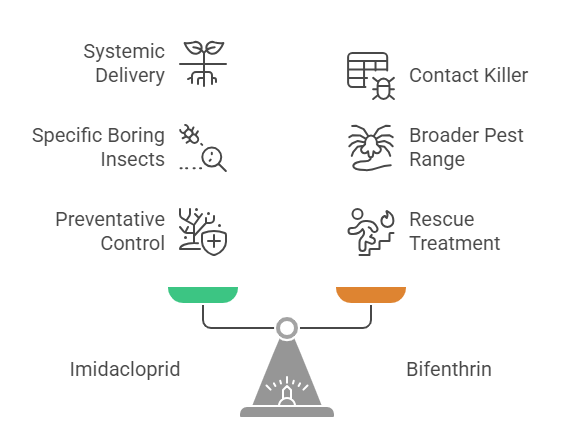
When comparing Imidacloprid and Bifenthrin, the first thing to understand is their "delivery" method to the insect. Imidacloprid is famously systemic. When applied as a soil drench or foliar spray, the plant tissue absorbs the active ingredient. This means that any insect that bites or sucks the sap of the plant—such as aphids, whiteflies, or emerald ash borers—will ingest the toxin. Because it is inside the plant, it is protected from being washed away by rain or degraded by UV light, leading to long-lasting internal protection.
Bifenthrin, on the other hand, is a contact killer. It does not move through the plant's vascular system. Instead, it stays on the surface of the leaves, soil, or structures where it is applied. When an insect crawls over a treated surface or is directly hit by the spray, the chemical enters through its exoskeleton. It is highly effective against a broader range of pests, including spiders, ants, and mosquitoes, which might not actually "eat" the plant but simply inhabit the area.
In industrial and large-scale agricultural settings, these two chemicals are often used in rotation. Using an imidacloprid insecticide allows for preventative, long-term control of specific boring insects, while Bifenthrin serves as an excellent perimeter defense or "rescue" treatment when an immediate outbreak is visible. Understanding these roles is crucial for bulk procurement and effective pest management planning.
The fundamental differences between Imidacloprid and Bifenthrin involve their chemical classification, systemic movement, target pest spectrum, and the speed of the "kill" (knockdown vs. slow ingestion).
| Feature | Imidacloprid (Neonicotinoid) | Bifenthrin (Pyrethroid) |
| Mode of Action | Systemic (Ingestion) | Contact & Ingestion |
| Speed of Action | Slower (requires ingestion/translocation) | Fast (Immediate knockdown) |
| Residual Life | Long (weeks to months inside plant) | Moderate (weeks on surface) |
| Target Pests | Sucking/Boring insects (Aphids, Grubs) | Broad Spectrum (Ants, Spiders, Fleas) |
| Water Solubility | High | Extremely Low |
| UV Stability | High (once inside the plant) | Lower (breaks down in sunlight) |
The systemic nature of imidacloprid pesticide means it excels in treating pests that are otherwise hard to reach. For example, wood-boring beetles or root-feeding grubs are shielded from contact sprays by bark or soil. Imidacloprid travels through the xylem, reaching these hidden pests. Bifenthrin, being non-systemic, is far superior for surface-dwelling pests like ants, crickets, or ticks that move across the ground or turf.
Because Imidacloprid has high water solubility, it is very effective for soil injections and drenching, but it requires careful management to prevent leaching into groundwater. Bifenthrin has very low water solubility and binds tightly to soil particles. This makes Bifenthrin the preferred choice for creating "chemical barriers" around building foundations or in areas where runoff into aquatic ecosystems is a concern, though it is highly toxic to fish.
If a facility is facing a sudden infestation of flies or mosquitoes, Imidacloprid will be too slow to provide relief. It requires the insect to feed on the plant and for the nervous system to gradually shut down. Bifenthrin provides an almost immediate "knockdown" effect, paralyzing the insect's nervous system upon contact. This makes Bifenthrin the better choice for immediate population suppression in B2B service sectors like hospitality or warehouse management.
Imidacloprid is a systemic insecticide belonging to the neonicotinoid family that mimics nicotine and targets the central nervous system of insects, primarily used for sucking insects and soil-borne pests.
As one of the most widely used insecticides in the world, Imidacloprid has revolutionized how we protect crops and turf. It works by interfering with the transmission of stimuli in the insect nervous system. Specifically, it causes a blockage in the nicotinergic neuronal pathway, which leads to the accumulation of acetylcholine, resulting in the insect's paralysis and eventual death. Because it binds much more strongly to insect neuron receptors than to mammal receptors, it is considered to have a favorable safety profile when used according to professional guidelines.
In the B2B sector, imidacloprid insecticide is frequently purchased in bulk for "Pre-construction" termite treatments or "Season-long" grub control on golf courses. It is available in various formulations, including flowable concentrates (SC), wettable powders (WP), and granular (G) forms. Its ability to be taken up by the roots makes it the gold standard for protecting ornamental trees and high-value timber from invasive species like the Hemlock Woolly Adelgid.
The longevity of imidacloprid pesticide is its greatest selling point. In many cases, a single soil application can protect a plant for an entire growing season. This reduces the labor costs associated with repeated spraying, making it a highly cost-effective solution for large-scale landscaping companies and agricultural operations. Furthermore, because the active ingredient is sequestered within the plant tissue, it minimizes the exposure risk to non-target beneficial insects that do not feed on the plant, provided it is not applied during peak bloom.
Bifenthrin is a high-performance synthetic pyrethroid insecticide and acaricide used for broad-spectrum control of over 75 different pests through contact and stomach action.
Bifenthrin is modeled after the natural pyrethrins found in chrysanthemum flowers, but it has been chemically engineered to be much more stable in sunlight and longer-lasting in the environment. It works by disrupting the sodium channels in the insect's nerve cell membranes. This leads to a rapid "fire" of the nerves, causing immediate twitching and death. Unlike Imidacloprid, Bifenthrin also acts as a repellent; many insects will avoid surfaces treated with this chemical, making it an excellent "perimeter defense" tool.
Professional pest control operators rely on Bifenthrin for "total yard" treatments or structural pest control. It is effective against a massive list of pests, including cockroaches, termites, ants, ticks, fleas, and spiders. Because it is an acaricide as well as an insecticide, it is one of the few chemicals that effectively manages mite populations. It is generally odorless, non-staining, and can be used both indoors and outdoors in specific concentrations.
From a B2B procurement perspective, Bifenthrin is valued for its versatility. While Imidacloprid is specialized for plant-feeding insects, Bifenthrin is the "all-purpose" tool in the arsenal. It is often the primary ingredient in professional-grade products used for mosquito misting systems and perimeter sprays. Its low volatility means it stays where you put it, providing a consistent barrier against encroaching pests for up to 90 days in ideal conditions.
Choosing between Imidacloprid and Bifenthrin depends on whether you need a systemic, long-term preventative (Imidacloprid) or a broad-spectrum, fast-acting contact killer (Bifenthrin).
You are dealing with sucking or boring insects: If your pests are aphids, mealybugs, scales, whiteflies, or wood-boring beetles, Imidacloprid is the correct choice.
You want long-term prevention: Soil drenching with imidacloprid pesticide can provide months of protection with a single application.
You need to protect the entire plant: Because it moves systemically, it protects new growth that emerges after the application has been made.
Labor costs are a concern: Fewer applications mean lower man-hours spent on the field.
You need immediate results: If an infestation is already present and causing visible damage, the "knockdown" power of Bifenthrin is required.
The pest is a non-feeder: For spiders, scorpions, or ants that are simply passing through, a contact spray is necessary.
You are treating structural perimeters: For protecting warehouses or offices from invading insects, Bifenthrin's residual barrier is superior.
You are targeting mites: Bifenthrin has acaricidal properties that Imidacloprid lacks.
| Scenario | Recommended Active Ingredient | Reason |
| Grub control in turf | Imidacloprid | Systemic action reaches the roots where grubs feed. |
| Perimeter ant control | Bifenthrin | Creates a repellent barrier on the foundation. |
| Emerald Ash Borer | Imidacloprid | Only a systemic can reach the larvae inside the tree. |
| Mosquito fogging | Bifenthrin | Provides immediate kill of airborne insects. |
| Indoor roach control | Bifenthrin | Low odor and safe for crack-and-crevice application. |
In many professional settings, a combination or rotation is the most effective strategy. For example, a landscaping firm might apply a soil drench of imidacloprid insecticide in the spring for season-long protection, and then use Bifenthrin for "spot treatments" if incidental pests like Japanese Beetles appear on the foliage later in the season.
In summary, neither Imidacloprid nor Bifenthrin is "better" in an absolute sense; rather, they are different tools designed for different tasks. Imidacloprid is the specialist—a systemic powerhouse that excels at protecting the internal health of plants and turf from specific feeding insects over a long duration. Its role as a preventative imidacloprid pesticide makes it an essential component of any large-scale agricultural or horticultural budget.
Bifenthrin is the generalist—a versatile, fast-acting contact killer that provides broad-spectrum control against a massive variety of pests. It is the go-to for immediate suppression and for creating defensive barriers around structures. For the B2B buyer, maintaining a stock of both chemicals allows for a flexible response to the diverse pest pressures found in commercial environments.
When selecting your product, always consider the environmental conditions of your site, the specific biology of the target pest, and local regulatory requirements. By understanding the mechanical differences between the systemic neonicotinoid imidacloprid insecticide and the contact pyrethroid Bifenthrin, you can ensure a more efficient, cost-effective, and successful pest management program.